I designed and built a thermal-conductivity test system to study how printed polymers move heat—part of research into lightweight protection for lithium-ion batteries.
Research intern · mechanical + experimental development
Scope
CAD · fabrication · firmware · thermal testing
Materials
Onyx and Nylon
Topologies
Gyroid and Diamond TPMS
01 / Mechanical design + drawings
Two enclosures. One integrated experiment.
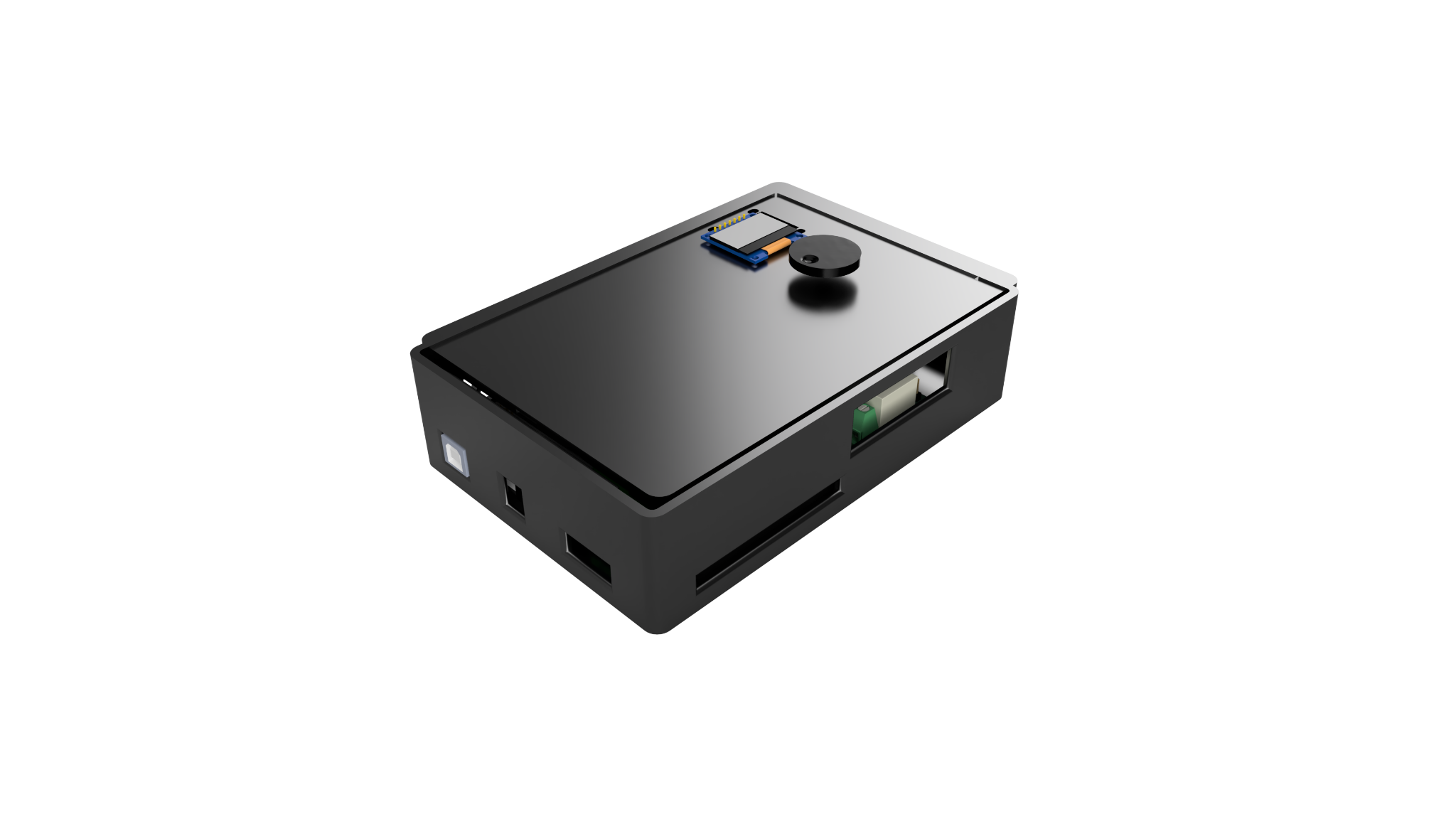
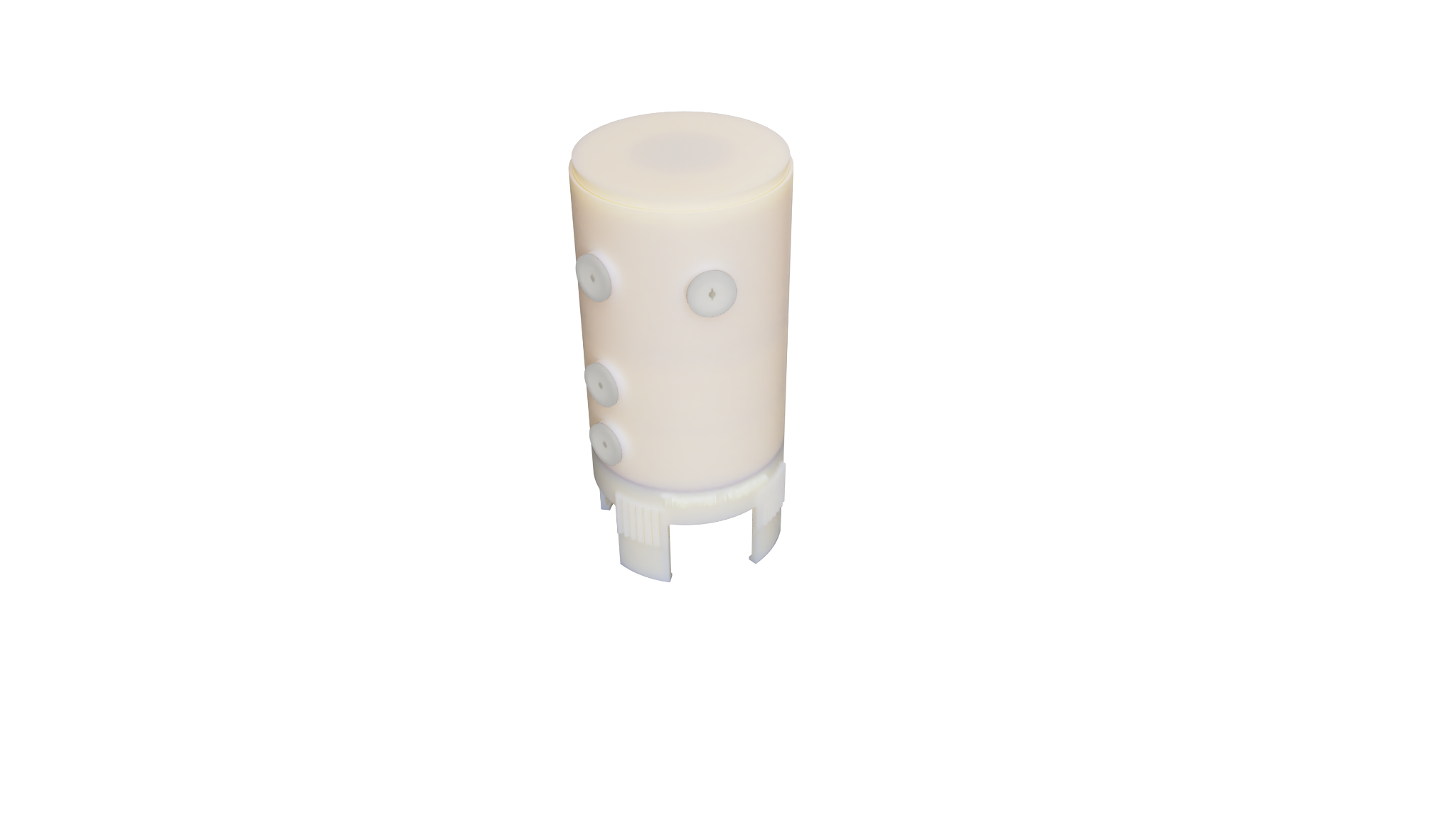
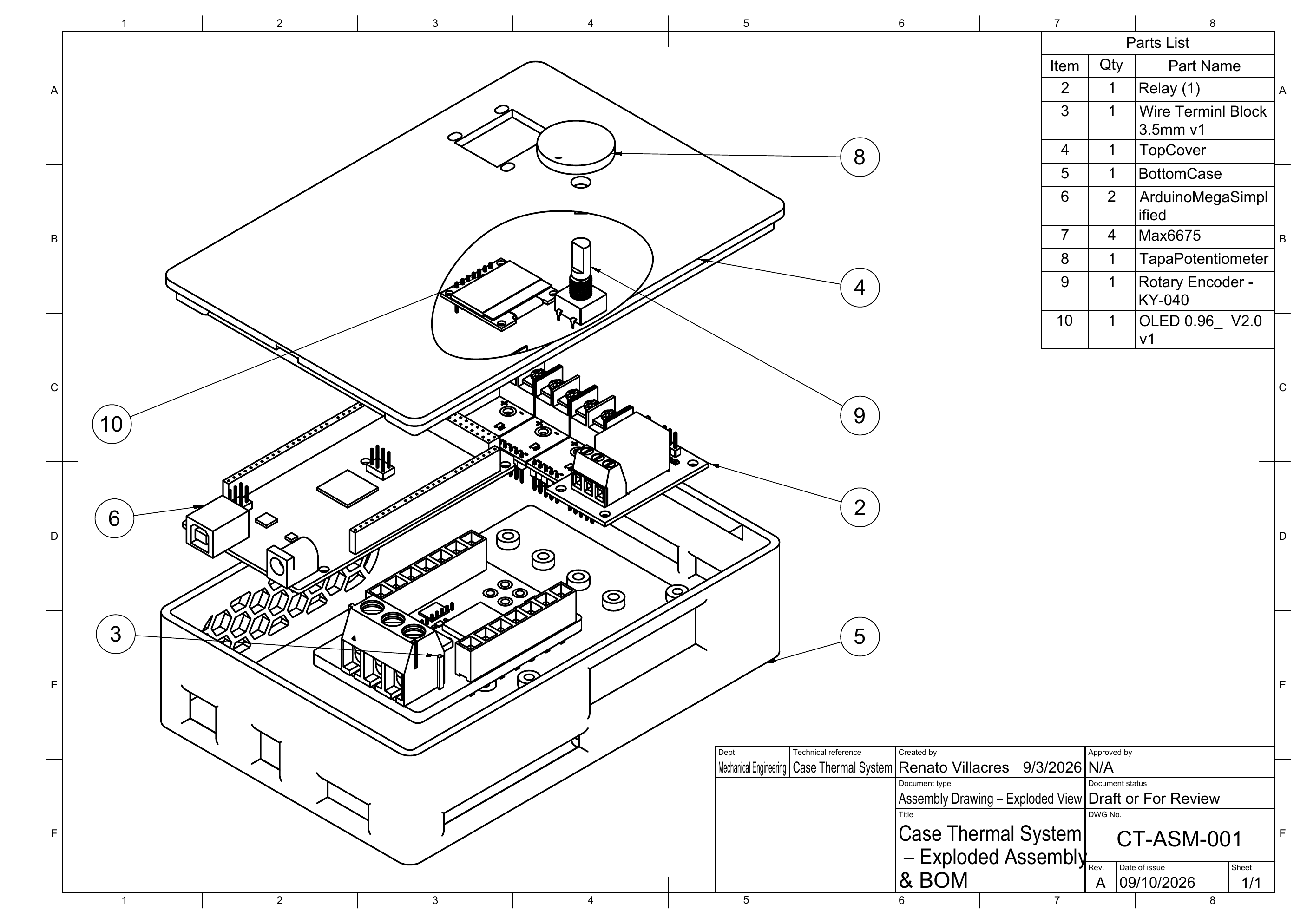
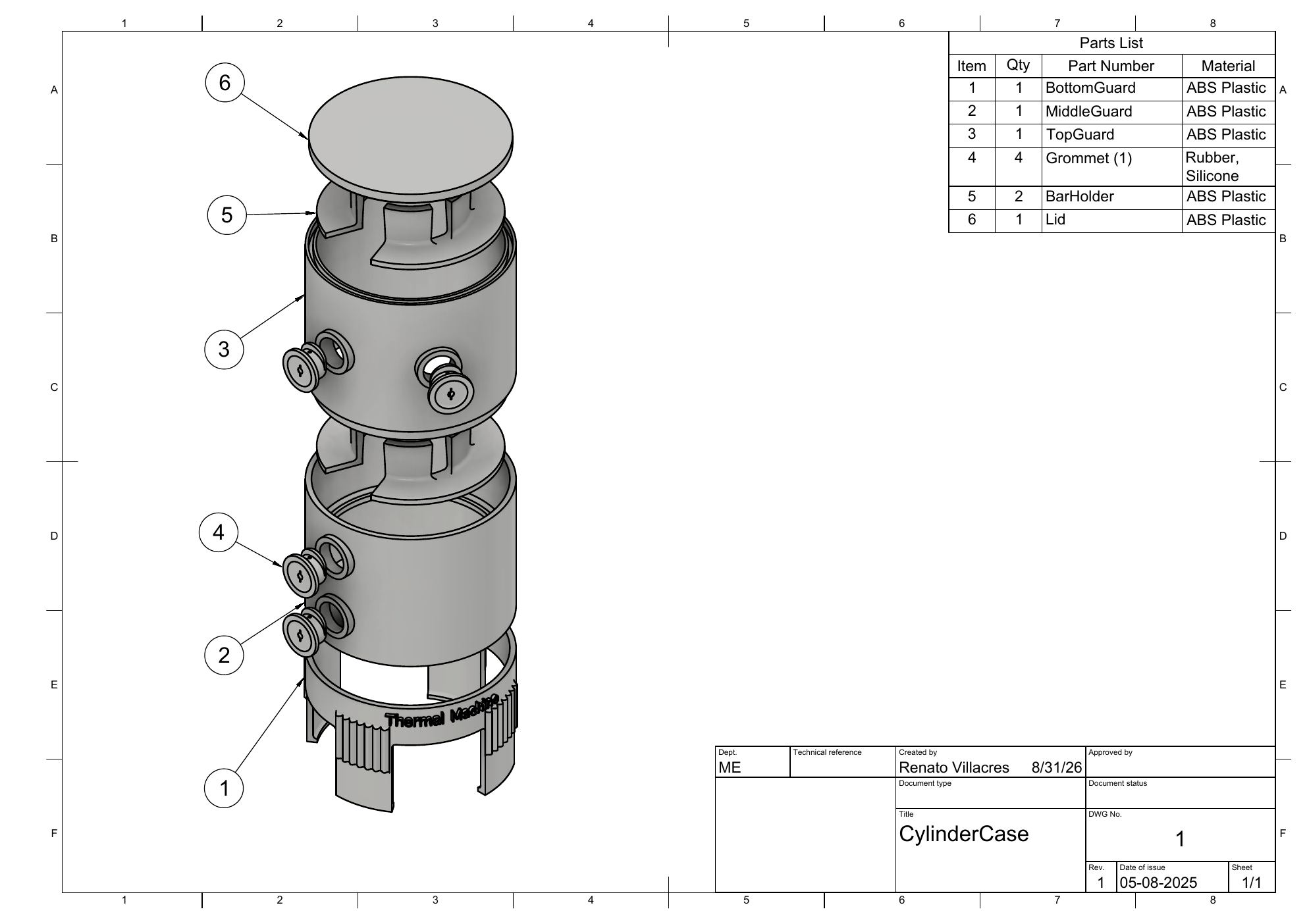
I developed two purpose-built enclosures around the experiment: a modular guard for the thermal stack and a serviceable controls case for the electronics, interface, and wiring. The final package includes the CAD assemblies and exploded drawings for both enclosures, with part callouts and bills of materials.
It starts with a battery failure that cooling alone cannot solve.
A damaged lithium-ion cell can enter thermal runaway: a self-heating reaction that may propagate through a battery pack and end in fire or explosion. Active cooling can move heat during normal operation, but a protective structure may also need to dissipate heat and carry impact loads after a crash.
The long-term research question is whether an architected material can do both. By controlling internal geometry instead of adding solid mass, a lightweight case could create continuous heat paths while retaining the structure needed for mechanical protection.
Research questionCan geometry make a polymer carry heat more effectively without giving up the structure needed to protect a battery?
This phase builds the thermal evidence and measurement platform. It does not claim a finished battery enclosure or completed crash validation.
03 / Research lineage
Continuation—with a new experimental system.
The work began from a rigorous thesis foundation, then moved into a new phase of literature review, design, instrumentation, testing, and analysis.
2024 · Foundation
César Alberto Rosales Vigueras
César's master's thesis established the thermomechanical framework, built the first comparative conduction apparatus, tested a broad family of porous structures, and used design-of-experiments and FEA to identify promising architectures.
“Thermomechanical Properties of Architected Materials” · Tecnológico de Monterrey
Research extension · My contribution
From prior findings to a repeatable V2 platform.
Updated the state of the art around TPMS heat transfer and composites.
Selected Gyroid and Diamond cases and rebuilt the sample workflow.
Redesigned the apparatus guard and created a dedicated controls enclosure.
Developed the Arduino interface, safety logic, and dual-path data logging.
Manufactured Onyx and Nylon samples and completed twelve thermal runs.
04 / Method
One study, built as a complete measurement chain.
01
Research
Revisit heat transfer, TPMS behavior, composite pathways, and prior findings.
02
Model
Generate controlled Gyroid and Diamond geometry in nTop.
03
Manufacture
Print matched 50.8 mm × 7 mm sandwich specimens in Onyx and Nylon.
04
Measure
Drive one-dimensional heat flow through the sample under a 60 N load.
05
Resolve
Filter thermocouple noise, calculate effective conductivity, and compare replicates.
Implicit sample modeling · nTop
Controlled geometry
Same envelope. Different internal pathways.
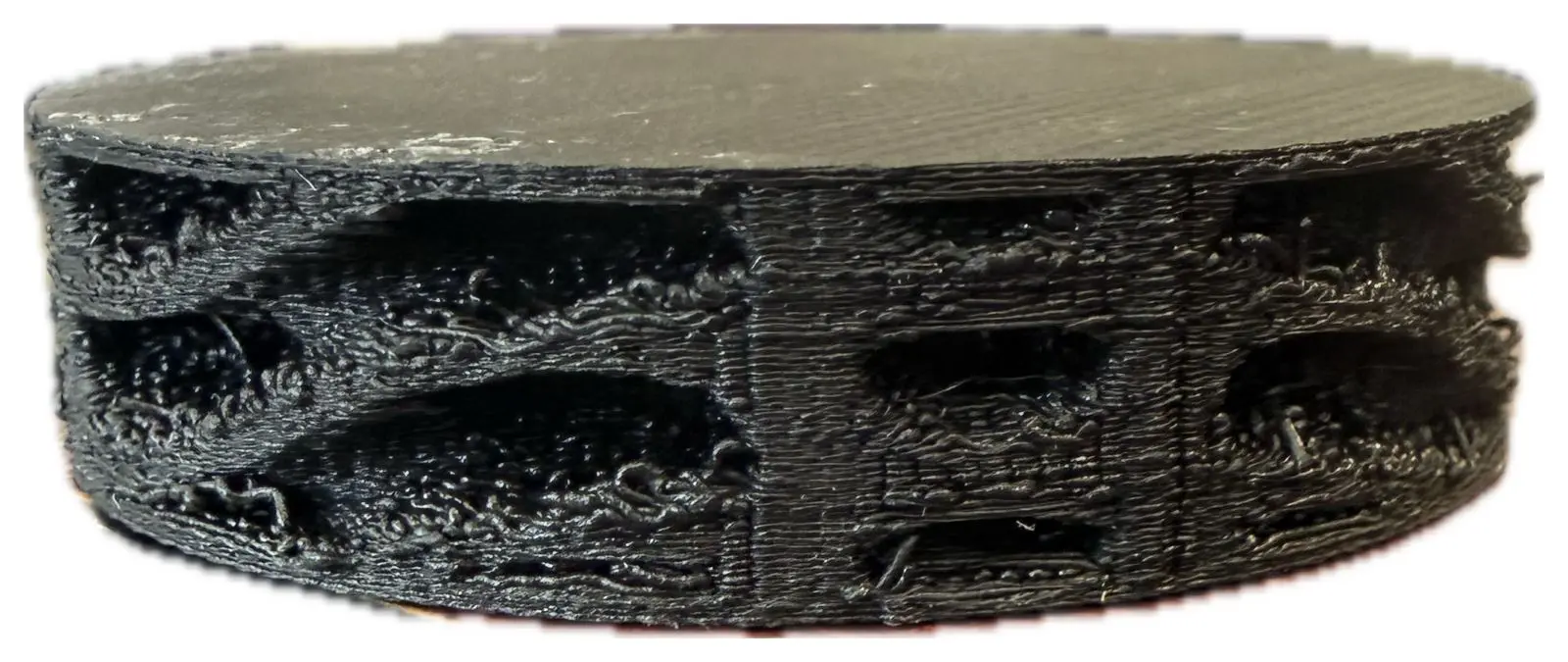
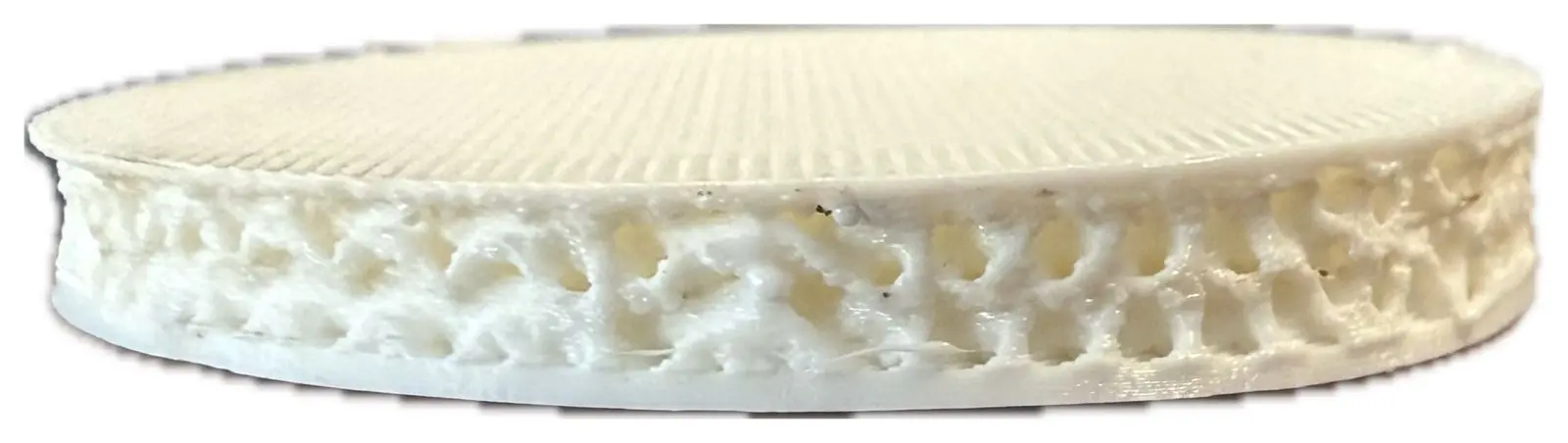
Every specimen used a 1 mm solid skin, a 5 mm porous core, and a second 1 mm skin. Holding the external geometry and print strategy constant made topology and material the variables that mattered.
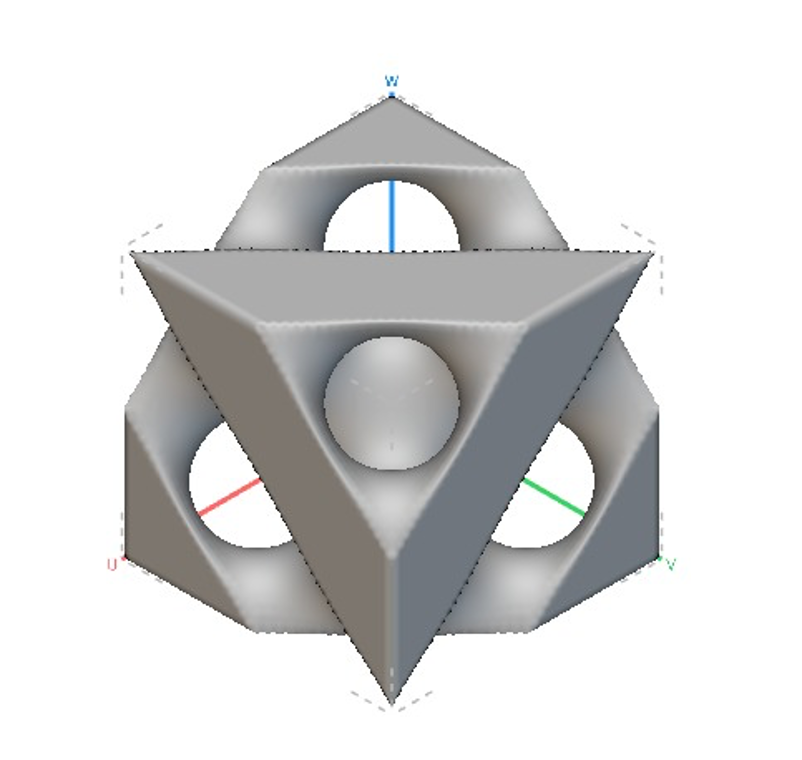
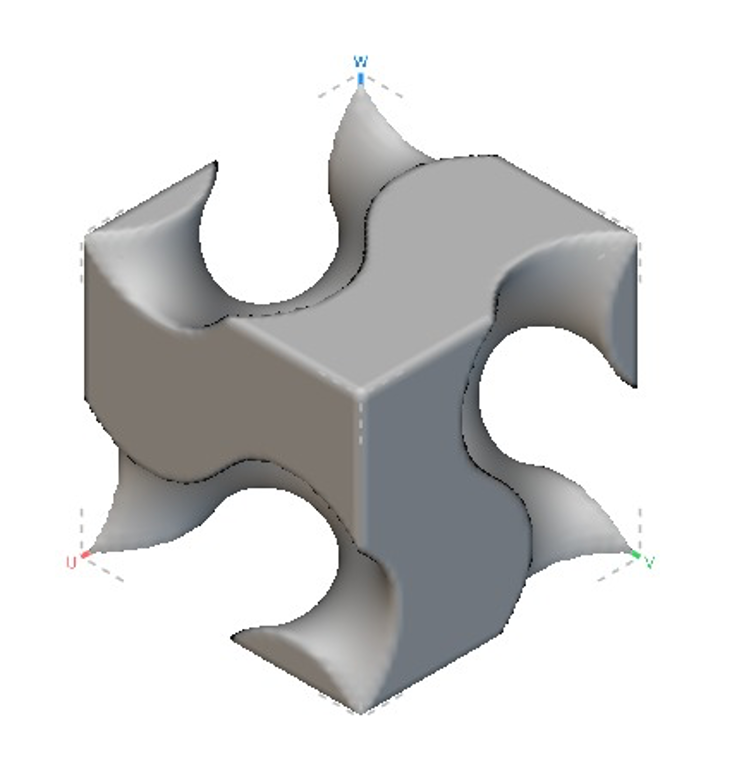
A triply periodic minimal surface repeats one small volume throughout the porous core. I compared two of those repeating cells—Diamond and Gyroid—inside the same specimen envelope so the internal pathway, rather than the outside dimensions, drove the comparison.
DiamondFour-fold diagonal pathways through a cubic repeating cell.DT-C3 samples · Onyx and Nylon
GyroidContinuous curved channels with no straight-through struts.GT-C4 samples · Onyx and Nylon
Unit-cell renders from the project model; the research specimens were generated in nTop.
06 / The apparatus
I rebuilt the rig around repeatability, safety, and use.
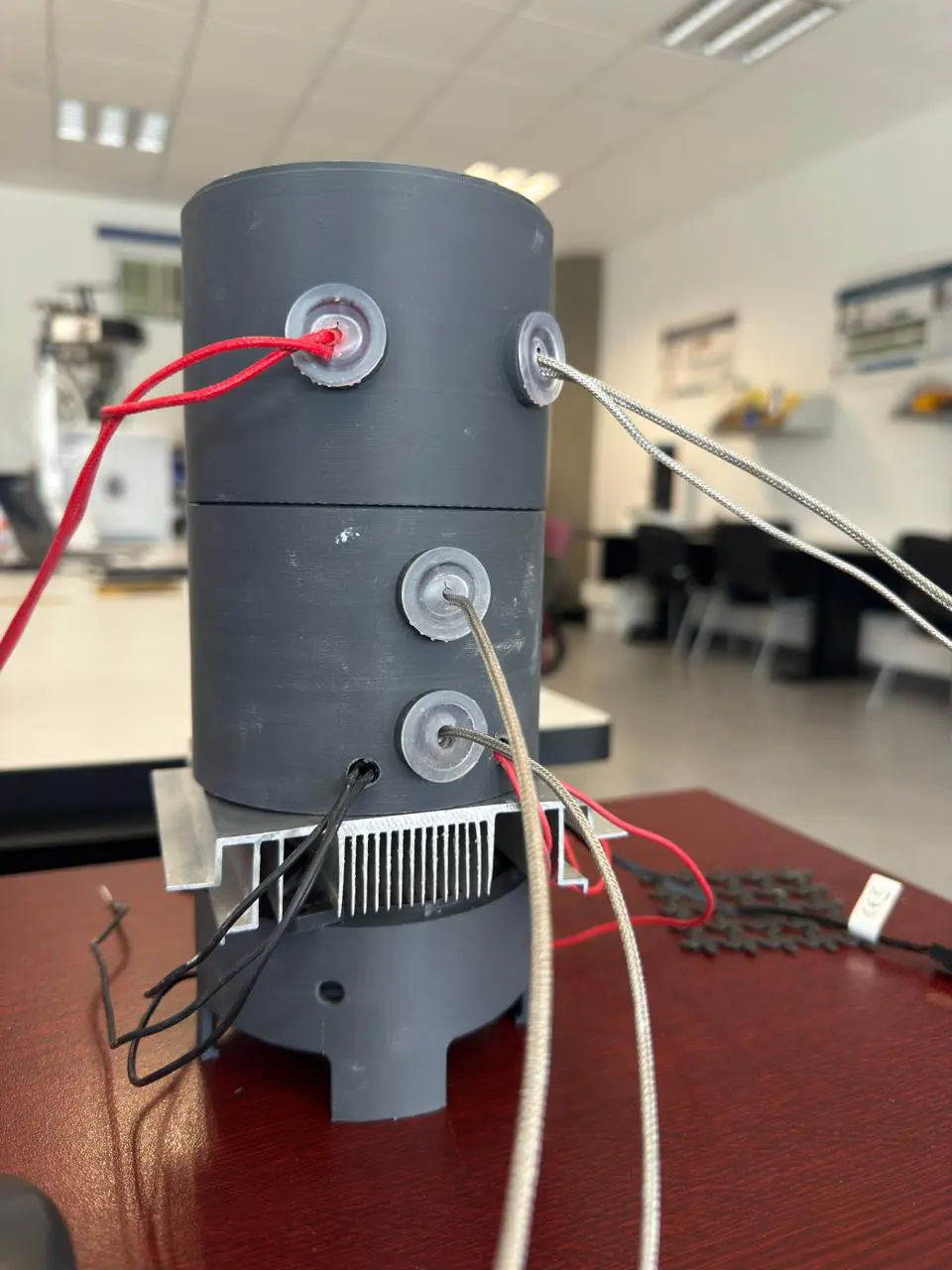
The core comparative-longitudinal method came from the thesis. The V2 work transformed that research setup into a more controlled system with modular guards, improved alignment, protected sensors, an enclosed controller, and a deliberate operator interface.
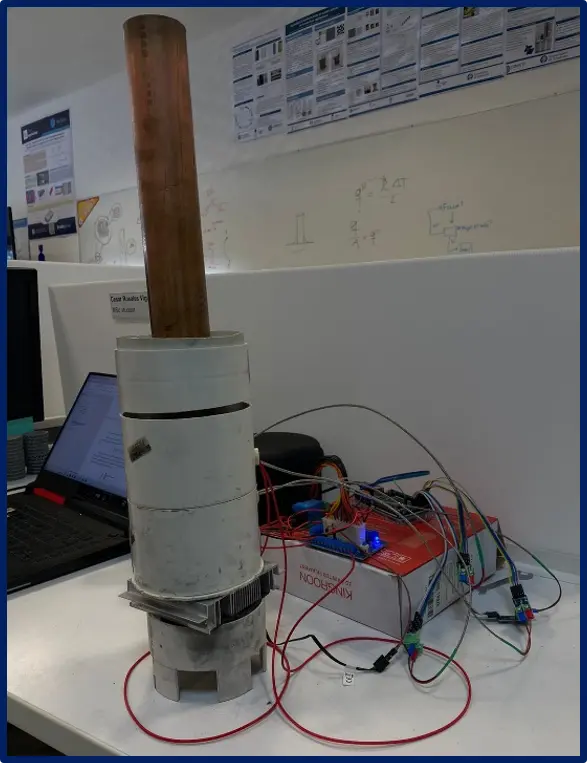
Before Original research apparatus
→
V2 Redesigned, assembled, and instrumented
Measurement architecture
A controlled thermal path from heater to sink.
Copper meter bars sit above and below the specimen. Four calibrated thermocouples measure the gradients used to calculate effective conductivity, while Peltier modules, a heatsink, and a fan control the cold side. The guard reduces radial loss and keeps the heat path close to one-dimensional.
60 N contact load
Dead weight
T1 · T2Copper bar 1
TPMS sample · 7 mm
T5 · T6Copper bar 2
Peltier modules · heatsink · fan
07 / Controls + acquisition
The machine does more than read temperatures.
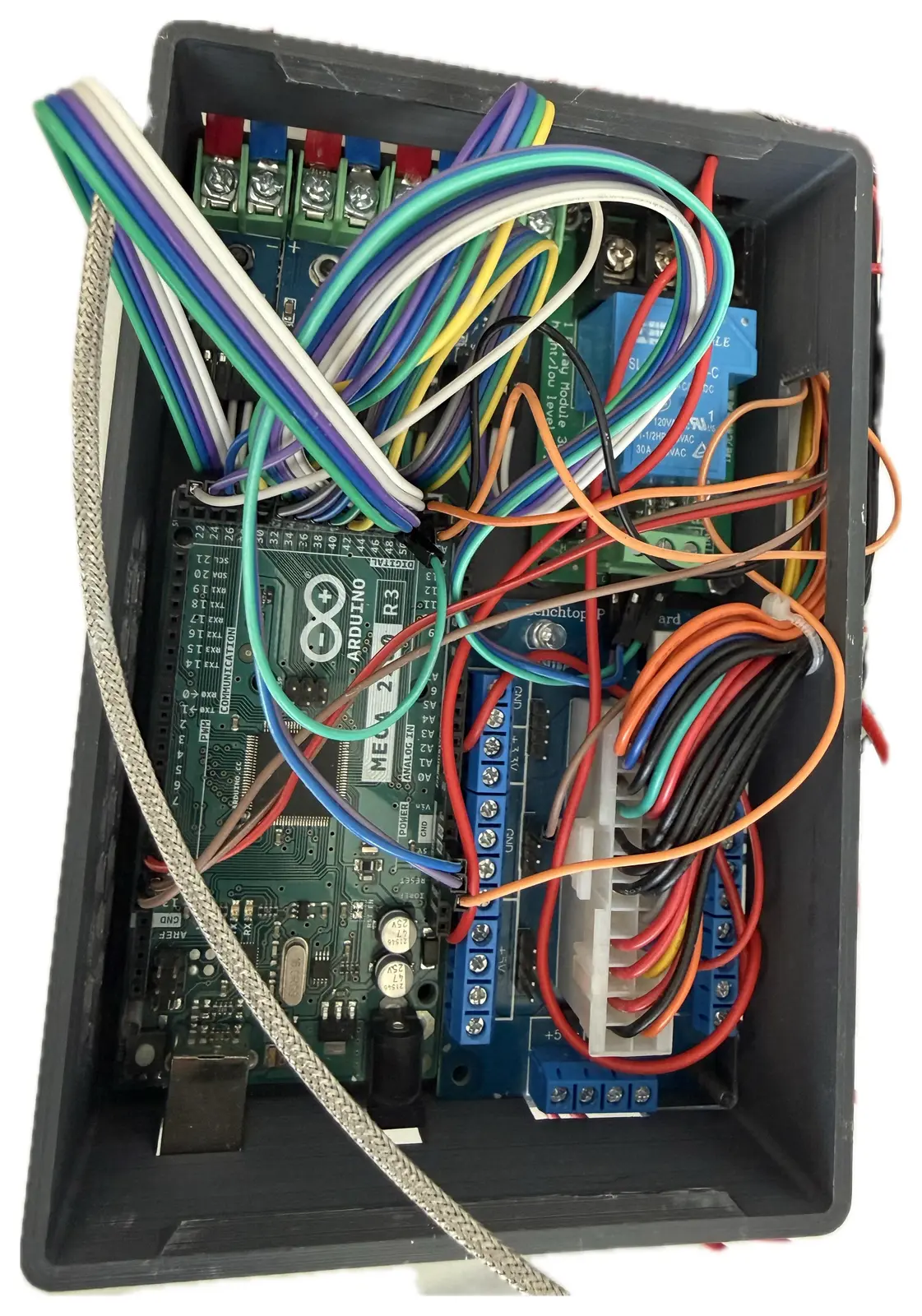
I wrote the Arduino control system as an operator-facing experiment: guided test phases, live sensor values, a compact trend display, temperature safety logic, and synchronized logging to both SD and a serial data stream.
0112 V preheatRapid approach to target
025 V soakStabilize the gradient
03Test + log1 Hz temperature and ks
52.5 °C
normal transition target
60 °C
safety transition threshold
4 channels
MAX6675 thermocouple acquisition
Dual log
SD card + PLX-DAQ serial stream
Live menu, thermal cycle, and spreadsheet logging
From CAD to physical integration.Arduino Mega, relays, power distribution, and sensor wiring installed inside the enclosure.
08 / Thermal results
Topology changed the outcome in both materials.
Each material-topology combination was run three times. The values below are the reported mean effective thermal conductivities after smoothing the steady measurement window.
1.61.20.80.40.0
1.605
OnyxGyroid
1.103
OnyxDiamond
1.039
NylonGyroid
0.694
NylonDiamond
Mean effective thermal conductivity · W/m·K
01
Gyroid led twice.
It measured about 46% above Diamond in Onyx and 50% above Diamond in Nylon, preserving the same topology ranking across both materials.
02
Material still mattered.
Onyx produced the higher mean conductivity for both geometries, consistent with its chopped carbon-fiber-filled matrix.
03
≤1.43% CV in Onyx replicates.
Across both Onyx configurations, three-run coefficients of variation stayed at or below 1.43%. Nylon kept the same topology ranking but showed greater spread—an important target for the next validation cycle.
Reported replicate values and means · W/m·K
Material
Topology
Run 01
Run 02
Run 03
Mean
Onyx
Gyroid · GTC4
1.616
1.579
1.621
1.605
Onyx
Diamond · DTC3
1.102
1.115
1.093
1.103
Nylon
Gyroid · GTC4
0.953
0.950
1.215
1.039
Nylon
Diamond · DTC3
0.660
0.657
0.764
0.694
These measurements characterize the printed samples and the experimental platform. Mechanical compression testing and FEA are still required before making a complete thermomechanical or battery-protection claim.
09 / What this unlocks
The rig is working. The research can now move forward.
The immediate next step is to connect the thermal evidence to structural performance, then carry the best architecture into a battery-relevant demonstrator.
01Mechanical compression tests for the selected samples
02Thermal and mechanical FEA validation
03New lattice variations and selective reinforcement
04Small-scale battery spacer or protective case testing
Research conducted with Tecnológico de Monterrey's School of Engineering and Sciences and POLYMATIQ, with Cecilia D. Treviño Quintanilla, Guillermo Sotelo Flores, and Benjamín A. Moreno Núñez. Research foundation credited to César Alberto Rosales Vigueras's 2024 master's thesis.